Oleh:
NUR NADHIRAH BINTI MOHD RASLAM
Pensyarah Diploma Pengurusan Industri Halal
Kolej UNITI Kota Bharu
When travelling overseas, access to halal food can be quite limited. What are our options anyway? We have vegetables and fruits, but as Malaysians, this may not be sufficient. We need something heavier, something more satisfying, something filling. So, what is it? Bread! Some of us choose bread. It is made from wheat and a combination of flour and sugar. What could go wrong, right? As long as we avoid choosing ones with meat fillings, it should be fine. But here is where things can go wrong. Let us deep dive into the ingredients of bread to understand where the concern lies.
Bread is made from flour, a lot of it, whether wheat, whole wheat, or other types of flour suitable for forming bread. Besides flour, bread also contains sugar and salt. Maybe you sense nothing is wrong at this point, but have you ever wondered what makes bread so incredibly soft and so fluffy that every bite feels heavenly and melts in your mouth with a pleasant, splendid experience? It feels like every kneading of the dough was done with love and passion. Do you think only these basic ingredients can produce such a heavenly taste?
One of the ingredients that contributes to the specialty of bread is L-cysteine, which usually acts as a bread improver. This ingredient has not been widely debated socially or caused an uproar in our country the way the infamous gelatin did. But its very presence in our bread should be scrutinised.
L-cysteine is an amino acid and the basic building block of protein. It functions as a dough conditioner in bakery products or acts as a processing aid during bread making. In other words, it helps control dough behaviour, specifically how well the dough can be kneaded, and it reduces stickiness. It also contributes to softer dough and elasticity, and is responsible for helping the dough hold its shape without shrinking.
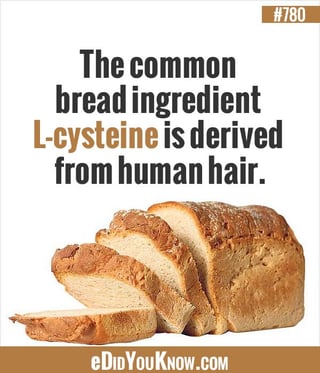
Why should L-cysteine be a cause for concern? It comes down to its source. Cysteine is usually extracted through a process called keratin hydrolysis, which involves breaking down hair or feathers into liquid or powder form. The keratin sources commonly used in this process include pig bristles, duck feathers, cow horn and human hair, with poultry feathers being the most dominant source in today’s industry, particularly from China. It is worth noting that a growing number of manufacturers now produce L-cysteine through bacterial fermentation using plant starch, which is considered a halal-friendly and synthetic alternative. The concern lies in products that do not clearly disclose their source.
So where does Islamic ruling stand on this? Two authorities provide clear guidance. According to the decision of the 90th Muzakarah (Conference) of the National Fatwa Committee Council, using the hair, fur, or feathers of animals that are permissible to eat (halal) as food ingredients is PERMISSIBLE (HARUS), whether harvested while the animal is alive or after it has been slaughtered according to Islamic law (Syariah). However, L-cysteine derived from sources that are not halal, including pig bristles, remains PROHIBITED (HARAM).
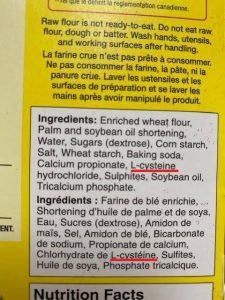
Examples of products containing L-cysteine.
The matter becomes even more serious when human hair is involved. The Mufti of the Federal Territory, in Al-Kafi #2039, has ruled clearly that the use of human hair extract as a food ingredient is HARAM. The ruling is grounded in the dignity and honour bestowed upon every child of Adam. As the Mufti’s office stated, the standing of a human being is not equivalent to that of other creatures, and therefore human body parts cannot be used as food or traded as commodities. This position is also consistent with the consensus of scholars from all four major Islamic schools of jurisprudence, who agree that human hair cannot be sold or exploited by others, owing to the sanctity of the human body.
Check your labelling before consuming any bread overseas and even here in our country when no halal logo is displayed. If the ingredient list does not explicitly state the name “Cysteine” or an equivalent term, you may check for the E-numbers E910, E920 or E921. Some products may implicitly list the ingredient only as “dough conditioner.” Be cautious.
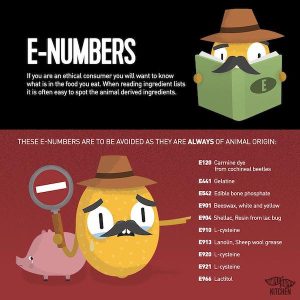
E-Code related to animals